Language
Our first time technology. How grammar, rhetoric, and philology built the cognitive infrastructure for coordinating lives across past, present, and future, long before computation existed.
Language, time, and the rise of information
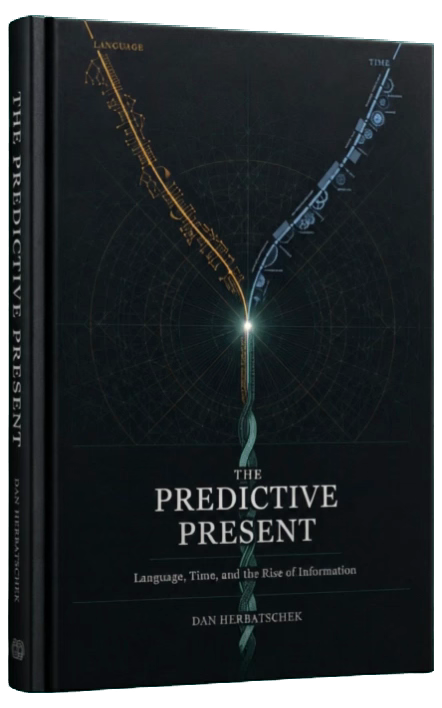
Publishing December 21, 2026
Language, time, and the rise of information
A sweeping intellectual history of how language, time, and quantification braided together across centuries, and how that braid produced the predictive world we now inhabit.
About the book
On an ordinary morning, the future arrives in small, polite suggestions. A phone finishes our sentences in pale gray. It decides which messages rise and which sink. It recommends what to watch, where to eat, who to follow, what to believe is happening now.
We are used to thinking of this as a technological condition: data, algorithms, artificial intelligence. But it is also a linguistic condition, and a temporal one. The modern world does not merely run on electricity and code. It runs on how we represent time, how we render experience into language, and how we translate both into quantities that can be compared, stored, transmitted, and acted upon.
This book traces that transformation from its deepest roots to its most contemporary consequences, from the grammar of ancient languages to the architecture of modern prediction engines.
Extended synopsis
The Predictive Present weaves three threads together, language, time, and information, but it is not a book with three separate topics. It is a book about the braid that forms when these threads tighten over centuries.
"Language is our first time technology. Before clocks and calendars, before ledgers and databases, language made time shareable."
The book begins from a simple observation that becomes, on inspection, surprisingly deep: language allowed humans to point beyond the immediate, to yesterday, tomorrow, soon, and still, to turn fleeting experience into narrated sequence, and to bind the future with commitments. The grammar of tense and aspect, the modest machinery of "already" and "not yet," the social force of "I will," these are not ornaments of speech. They are tools for coordinating lives across time.
Yet language alone does not scale. As communities grew into cities, and cities into states, the temporal work of language had to be supported by something more durable than voice: records, schedules, standardized measures, and the immense human labor of administration. We began to externalize time, into writing, archives, and institutions.
Then we did something even more consequential. We began to count. And counting is a transformation. It requires that experience be broken into units, that the rich texture of the world be rendered into categories. Along the way, this translation begins to tempt a particular dream: that if language could be made purer, more regular, if its ambiguities could be eliminated, then thought itself might become more reliable, and the world more governable.
"The present becomes predictive not because we make forecasts, but because forecasts become infrastructure."
The world we inhabit now is defined by a further step. The translation of language and time into measurable information has been joined to systems that continuously infer what comes next. In markets, in policing, in credit, in advertising, in the daily texture of attention, the future is treated as something that can be brought forward into the present as a score, a ranking, a risk, a recommendation.
The book is not a claim that quantification is a villain, nor that narrative is a relic. It is a claim that modern life is shaped by how these modes of knowing interact, and by how often we forget that they are modes, not mirrors.
From the author
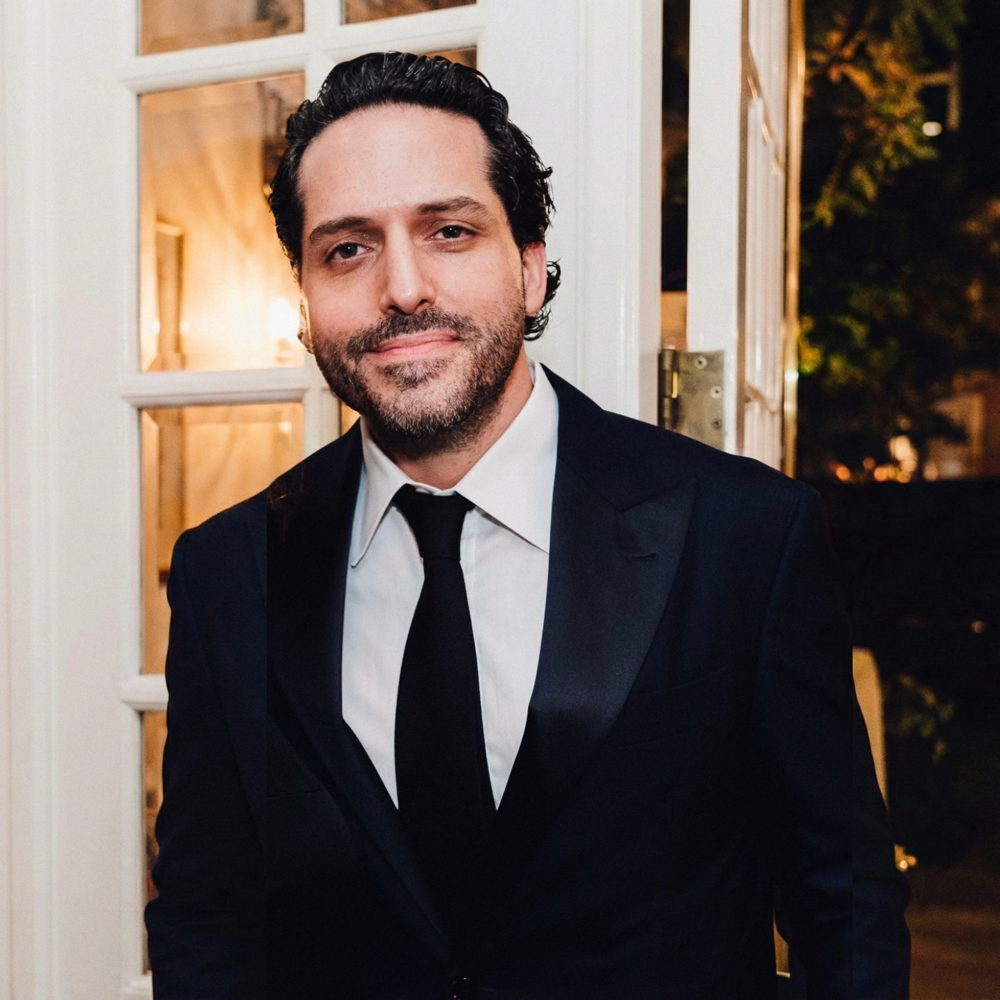
I have spent years working at the intersection of language, technology, and strategy. Over time I began to notice that the conversations happening in AI, in data science, in platform design, and in digital governance were all circling the same set of questions, questions that were far older than any of us realized.
The dream of a predictive world did not begin with machine learning. It began the first time a community decided to standardize its calendar. It deepened when someone first tried to build a language free of ambiguity. It accelerated when probability became a tool for managing uncertainty rather than merely describing it.
I wrote this book because I wanted to understand, and to help others understand, the long arc that produced the particular world we now live in: a world that is always slightly ahead of itself, always refreshing, always anticipating. Not to condemn that world, but to see it clearly enough to decide what parts of it we want to keep, and what parts we might choose to change.
A civilization that organizes itself around prediction risks confusing the world with its models of the world, mistaking quantified legibility for truth, and allowing what is easy to compute to dominate what is hard to name. The predictive present is not only a technological condition. It is a cultural achievement and a cultural decision. To see that is to regain, at least a little, the ability to decide what time will feel like.
Key themes
The book moves across disciplinary boundaries, history, linguistics, mathematics, philosophy, computer science, political economy, always returning to the same central braid.
Our first time technology. How grammar, rhetoric, and philology built the cognitive infrastructure for coordinating lives across past, present, and future, long before computation existed.
From ritual calendars to atomic clocks, from seasonal cycles to the perpetual refresh of the feed. How societies externalized, standardized, and eventually computed time itself.
Once time is counted it can be scheduled. Once obligations are counted they can be priced. Once language is encoded it can be modeled. The transformation of meaning into signal.
When forecasting becomes infrastructure: how scores, rankings, and recommendations reshape attention, opportunity, and governance. Prediction as a mode of power, not merely knowledge.
Not as a sudden rupture but as the latest turn of a very old story: the gradual construction of a world in which the future can be treated as something like a calculation.
Who this book is for
This book is written for the intellectually curious general reader. No specialized background is required beyond patience for careful distinctions.
How concepts like "information," "data," and "prediction" acquired their modern meanings.
How grammar makes time navigable and how formal languages laid the groundwork for computation.
Not as a technical manual but as intellectual history: where these ideas actually came from.
How standards, categories, and metrics shape what counts as real, valuable, and governable.
How measurement, instruments, and mathematical abstraction changed what knowing means.
How the feed, the recommendation, and the score structure daily attention.
Sweeping, narrative-driven nonfiction that treats ideas as historical forces.
For anyone who senses that something fundamental has changed about how we experience time.
Frequently asked
AI is a major part of the story, but the book is not a technical guide to machine learning. It traces the much longer intellectual history that made AI thinkable, from ancient grammar to probability theory to information compression, and asks what it means that prediction has become infrastructure.
No. The book is written for intellectually curious general readers. When a small amount of mathematics clarifies the story, it is included in short windows, not to prove, but to illuminate. No specialized training is required beyond patience for careful distinctions.
Most books about data begin in the twentieth century. This one begins with language itself, with the grammar that made time shareable. It argues that the predictive present is not merely a technological condition but a cultural and linguistic one, built across centuries of standardization, quantification, and formalization.
Publication details will be announced on this page. Pre-order to be notified as soon as a release date is confirmed.
Format details, including audiobook availability, will be announced closer to publication. Follow this page for updates.
Not at all. The book's argument is that we cannot step outside quantification, and we should not wish to. But we can choose what we quantify, how we interpret what numbers can and cannot say, and how we keep human meaning alive inside systems that prefer the thin and the countable.
Understand the braid that made it possible.
Kindle edition · December 21, 2026
Pre-order on Amazon for $12.99
No account. One message, when print is confirmed.
You are on the list. We will write when a print edition is confirmed.